AI Accounting vs. Manual Bookkeeping: Which is More Efficient for Business?
Which Option Makes More Sense?
- AI accounting is more efficient for businesses with routine transactions, many invoices, and the need for fast reporting.
- Manual bookkeeping can still be used for small businesses with very few transactions, for example under 30 transactions per month.
- AI can reduce manual input and recap work by up to 50–80%, depending on the neatness of the data.
- With best accounting software, financial reports can be monitored more quickly without waiting for the end of the month.
How to Compare AI Accounting and Manual Bookkeeping
Manual bookkeeping typically relies on Excel, transaction records, payment receipts, and one-by-one input by the admin or finance department. This method still works, but it becomes increasingly cumbersome as transactions increase. The more invoices, receipts, reimbursements, and vendor payments there are, the greater the risk of data delays or incorrect input.
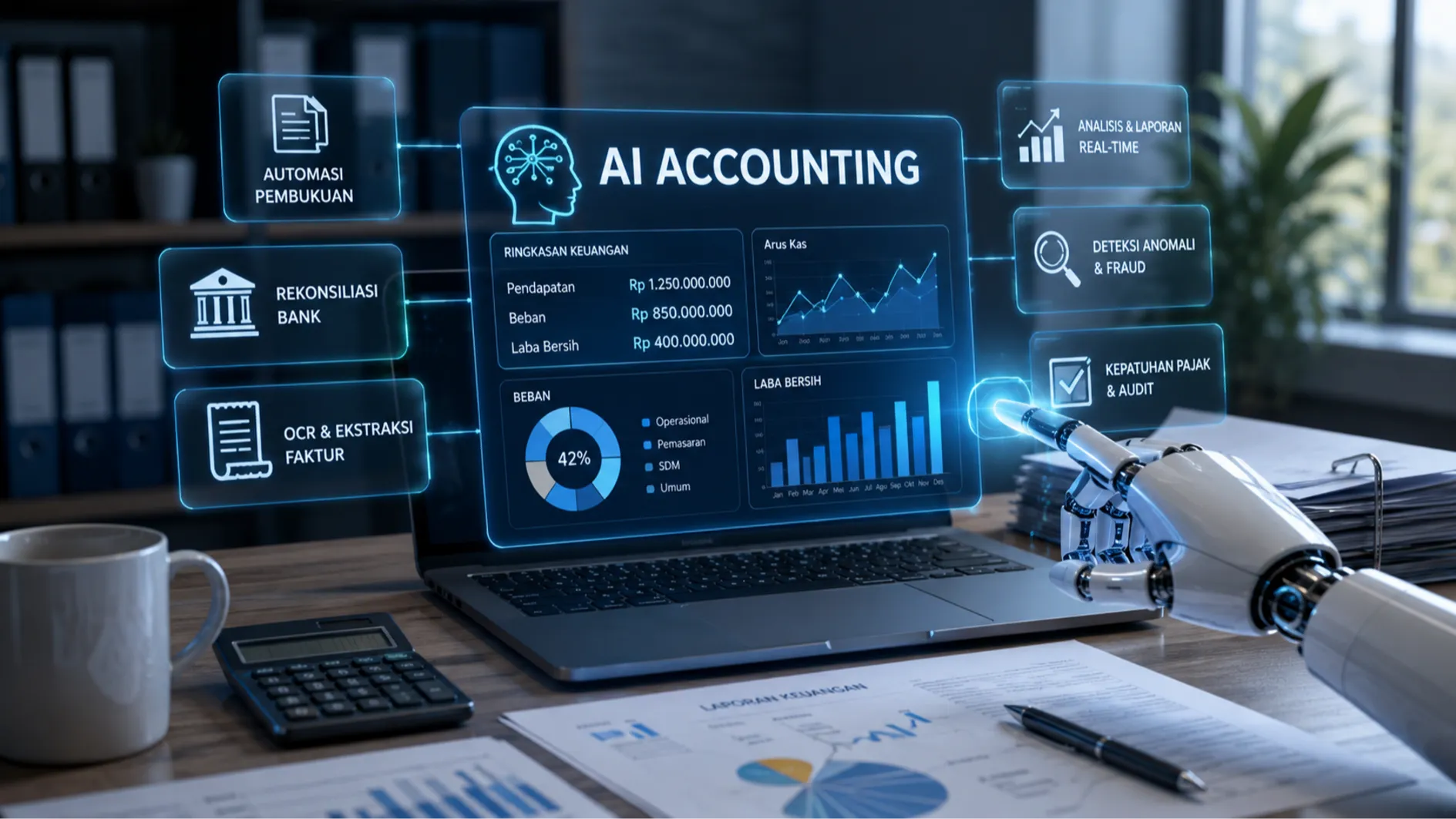
AI accounting works with a different approach. The system reads transaction data, helps classify accounts, matches payments, and then automatically updates reports. When businesses use AI accounting, best accounting software, the finance process is no longer completely dependent on manual recaps.
A real-life example: a business with 300 transactions per month. If manual input takes 2 minutes per transaction, the total time spent is approximately 600 minutes, or 10 hours, just for input. That doesn't include double-checking, reconciliation, and reporting. With AI accounting, much of this process can be accelerated by reading data from invoices, bank statements, or transaction files.
Technically, AI accounting typically utilizes OCR, rule-based automation, and simple machine learning to identify patterns. For example, recurring monthly internet, software, or vendor payments can be automatically assigned to the same expense account. This reduces repetitive work that often overloads finance teams.
On the other hand, manual bookkeeping is more flexible for very simple situations. However, this flexibility often becomes problematic when a business starts to scale. File formats can vary, account names can be inconsistent, and transaction approvals can be difficult to track. Therefore, best accounting software more suitable for businesses that want neater data control.
Efficiency Isn't Just About Speed
Efficiency in bookkeeping isn't just about saving time. More important are accuracy, control, and speed of decision-making. A report that's seven days late can delay the owner's awareness of a cash flow shortfall.
With best accounting software, teams can view profit and loss reports, balance sheets, accounts receivable, accounts payable, and cash flow more quickly. If there are overdue invoices or duplicate payments, the system can help provide early alerts.
In operational experience, manual bookkeeping issues typically arise at the end of the month. The finance team must track transaction receipts, reconcile accounts, and categorize accounts. If there are hundreds of transactions, the monthly closing can be delayed by 3–7 business days. AI accounting helps eliminate this hurdle by recording transactions closer to the time of the transaction.
However, AI doesn't mean it's without review. Finance teams still need to validate unusual transactions, adjusting entries, tax returns, and large-value transactions. Therefore, the correct comparison isn't "AI replaces humans," but "AI reduces repetitive work so humans can focus on control."
For growing businesses, best accounting software provides significant value because the process is easier to audit. Data is not scattered across multiple files, change history is clearer, and reports can be generated more consistently.
Guide to Choosing the Most Suitable One
- If transactions are under 30 per month, manual may still be sufficient.
- If the transactions are 100+ per month, start using the system.
- If you are often late with monthly closings, evaluate your bookkeeping process.
- If you have a lot of invoices and proof of payment, use AI to read and match the data.
- If the owner needs real-time reports, select best accounting software.
- If account categories are often messy, tidy up the chart of accounts before migrating.
- If your business has a lot of approvals, use a system with clear tracking.
- Review the recording results at least once a week.
Use best accounting software It would be more optimal if the business had a consistent transaction flow from the start.
FAQ
1. Is AI accounting always better than manual bookkeeping?
Not always. For very few transactions, manual processing is sufficient. However, for businesses that are starting to grow, AI accounting is much more efficient.
2. Can AI accounting reduce human error?
Yes. The system helps read, group, and match transactions. Errors are still possible, but the risk is lower if data is checked regularly.
3. When does a business need to move from manual to AI accounting?
When transactions become difficult to monitor, reports are often late, or finance spends too much time inputting data.
4. Is AI accounting suitable for MSMEs?
Suitable, especially for MSMEs that have daily transactions, regular invoices, or many vendor payments. best accounting software can help the process to be neater.
5. Do you still need finance staff if you are already using AI accounting?
Still needed. AI helps with administrative tasks, while finance staff still handle validation, analysis, taxation, and approvals.
6. Is migrating from manual to system difficult?
It doesn't have to be difficult. Start with master data, a chart of accounts, a list of customers and vendors, and an opening balance. After that, the process can be done in stages.
Ultimately, the most efficient choice depends on transaction volume and control needs. For businesses that want faster reporting, lower input risk, and more readily analyzable data, best accounting software is a more strategic choice. With the right process, best accounting software not only helps with bookkeeping, but also strengthens business decisions. And for companies looking to scale up, best accounting software clearly superior to manual bookkeeping.