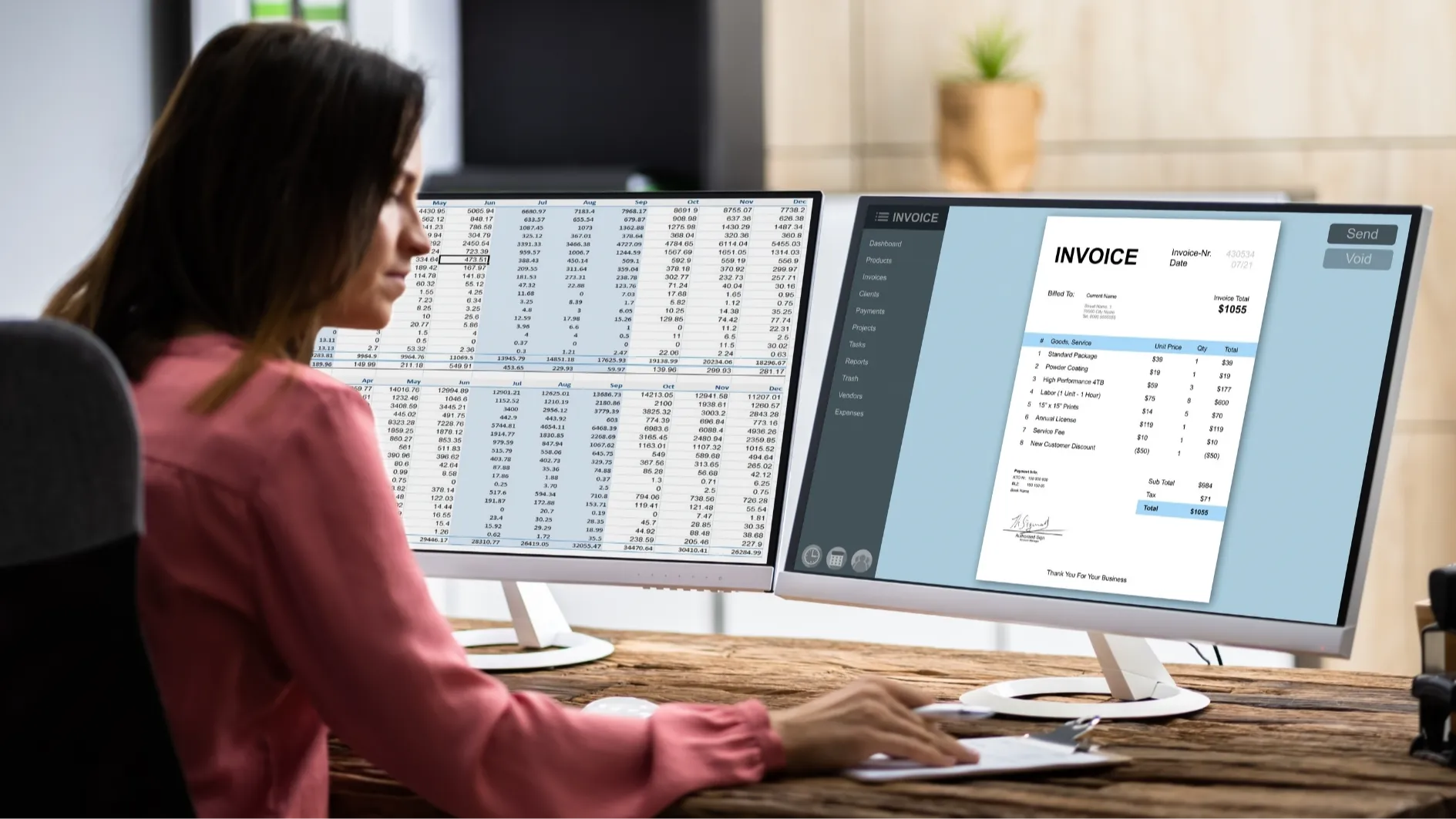
AI Accounting vs. Regular Accounting Software: What's the Difference?
Which One is More Appropriate for Your Business?
The short answer is that AI accounting and traditional accounting software are not interchangeable technologies. Accounting software provides the foundation for financial record-keeping, while AI accounting adds automation, analysis, and insight-generating capabilities from data.
Important points to understand:
- Accounting software focuses on recording and reporting transactions.
- AI Accounting is able to automate50–80%repetitive finance work.
- AI can help detect errors, analyze transaction patterns, and provide data-driven recommendations.
- AI works best when using best accounting software as the main data source.
- The greater the transaction volume, the greater the benefits provided by AI Accounting.
What are the main differences between AI Accounting and regular accounting software?
Many companies already use accounting software to create journal entries, record transactions, and prepare financial reports. However, with the advancement of Artificial Intelligence technology, a new question arises: is accounting software still sufficient?
The answer depends on the business needs.
Accounting software is designed to assist with financial administration processes. Users still need to enter data, reconcile accounts, review invoices, and ensure all transactions are recorded correctly.
On the other hand, AI Accounting not only records data, but also helps run various processes automatically.
For example, a company receives approximately2.000 invoiceevery month.
With regular accounting software, finance staff still need to open invoices, enter transaction data, select accounts, and check payments manually.
In AI Accounting, this process can be done faster.
Invoices are read usingOCR (Optical Character Recognition)The AI then recognizes the vendor name, transaction date, invoice number, and payment amount. The system then groups transactions by account category, performs bank reconciliation, and automatically updates financial reports.
All data remains stored inside best accounting software so that financial records remain neat and easy to audit.
Another difference lies in analytical capabilities.
Accounting software presents data entered by the user. Meanwhile, AI Accounting is able to study transaction history usingMachine Learningto find patterns that may not be visible manually.
For example, AI can detect increases in operational costs more than25%, find potentially duplicate transactions, or provide alerts when invoices are nearing maturity.
AI can also help run various automated processes, such as:
- Bank reconciliation.
- Monitoring cashflow.
- Reminder invoice.
- Approval workflow.
- Production analysis.
- Cash flow forecast.
Despite its many capabilities, AI Accounting still does not replace accounting software.
On the contrary, AI requires clean, consistent, and structured data to produce accurate analysis. Therefore, the use of best accounting software remains the main foundation before companies implement AI.
It is also important to understand that AI is not a replacement for accountants.
Auditing, taxation, financial strategy development, and business decision-making processes still require human experience. AI serves as a tool to speed up administrative tasks, allowing finance teams to focus more on activities that deliver strategic value.
By combining AI and best accounting software, companies can build financial systems that are more efficient, more accurate, and better prepared for future business growth.
How to Determine the Right Solution
- Use accounting software as a foundation for financial recording.
- Implement AI when transaction volume starts to increase.
- Use best accounting software as the center of all financial data.
- Start automating invoices and bank reconciliation.
- Make sure all transaction documents have been digitized.
- Implement approval workflows for important transactions.
- Evaluate automation effectiveness periodically.
- Scale up AI implementation according to business needs.
- Choose best accounting software which is easy to integrate with AI solutions.
- Make AI an analytical tool, not a substitute for human decisions.
FAQ
1. What is the main difference between AI Accounting and accounting software?
Accounting software helps record transactions and create financial reports, while AI Accounting adds automation capabilities, data analysis, and Artificial Intelligence-based recommendations.
2. Does AI Accounting replace accounting software?
No. AI requires data that comes from best accounting software so that the analysis and automation processes can run smoothly.
3. When should companies start using AI Accounting?
As transaction volumes increase, administrative processes become more complex, or the finance team spends too much time on manual work.
4. Is AI Accounting suitable for MSMEs?
Yes. MSMEs can start with invoice automation, bank reconciliation, and cash flow monitoring before developing other processes.
5. Can AI replace accountants?
No. AI helps with administrative work, while accountants remain responsible for auditing, taxation, business analysis, and decision-making.
6. What is the biggest benefit of AI Accounting?
Save time, improve data accuracy, speed up report preparation, and help management gain financial insights faster.
7. How to start implementing AI Accounting?
Start by selecting best accounting software which has complete features, structured data, and supports integration with AI technology so that digital transformation can be carried out gradually.