From Manual Bookkeeping to an Autonomous Business Based on AI and Automation: How to Get Started?
A Brief Overview of What You Need to Know
- The journey to Autonomous Business starts with digitalizing bookkeeping, not directly using AI.
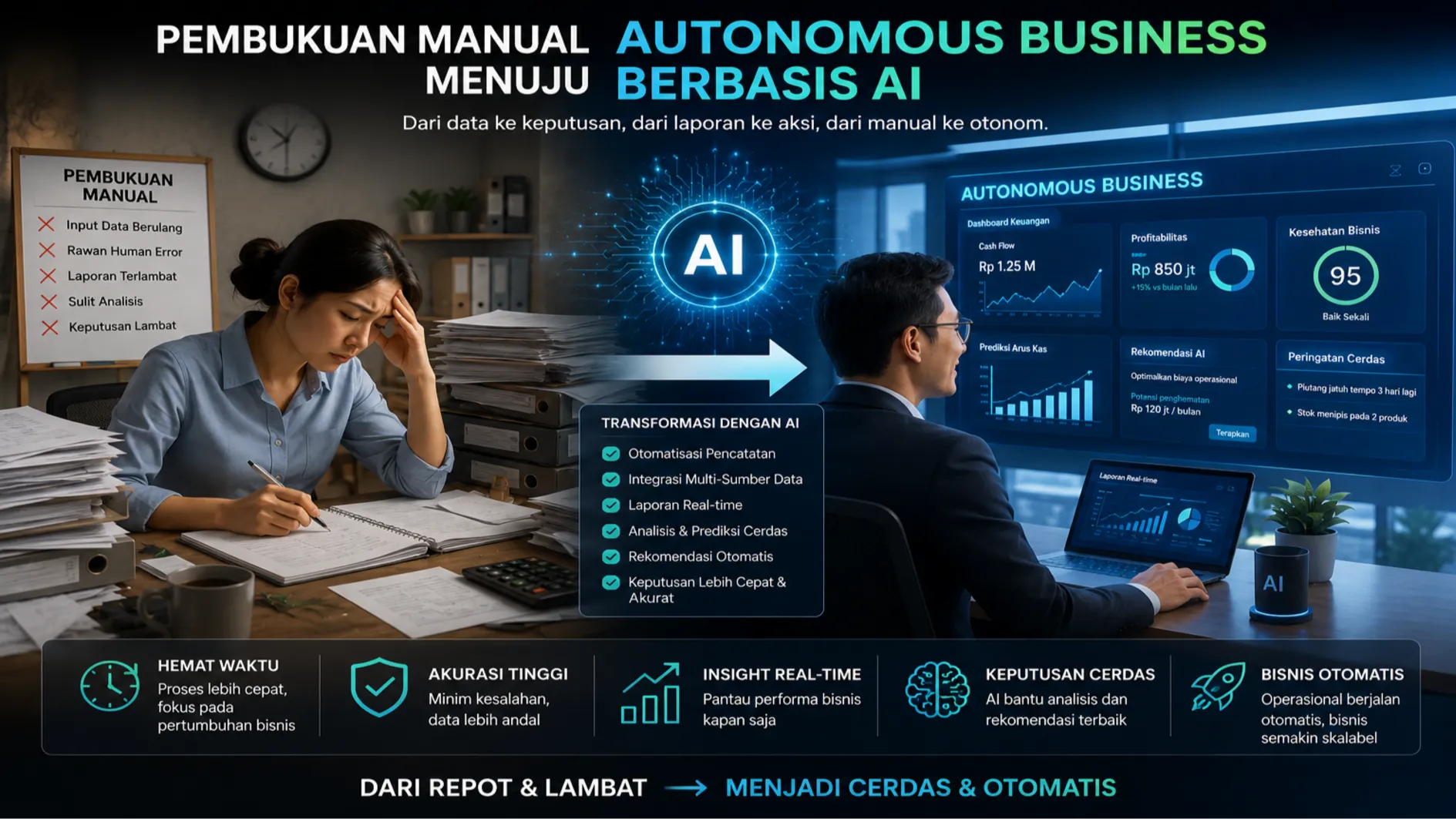
- Manual bookkeeping often slows down the analysis process and increases the risk of human error.
- Use best accounting software be the first step in building an accurate data foundation.
- Once data is organized, companies can implement automation and AI to increase operational efficiency by 20–50% in certain processes.
- The ultimate goal is to create operations that are able to work faster, smarter, and are data-driven.
Why Manual Bookkeeping Is No Longer Enough?
Many businesses still rely on manual record-keeping using books, spreadsheets, or separate files. This method may be effective when transactions are small, but it becomes challenging as the business grows.
The more transactions, the greater the risk of input errors, duplicate data, and late reporting. As a result, business owners often make decisions based on outdated information.
Because of this, many companies are starting to switch to using best accounting software so that all transactions are recorded automatically, more accurately, and easy to monitor at any time.
This step is not just about changing the way we record finances, but building a data foundation that will be used by automation and Artificial Intelligence (AI).
The Journey from Manual Bookkeeping to Autonomous Business
The transformation towards Autonomous Business is generally done in stages, not all at once.
The first stage is the digitalization of bookkeeping. All sales, purchases, expenses, and payments are recorded through best accounting softwareso that the data is stored in one integrated system.
The next step is implementing Finance Automation. Invoices can be generated automatically, payments reconciled without manual processing, and financial reports can be updated in real time.
Once these processes are stable, AI begins to take on a larger role. AI analyzes financial data, detects spending patterns, predicts cash flow for the next 30–90 days, and even provides recommendations for improving operational efficiency.
At the Autonomous Business stage, the system not only provides insights but is also capable of running automated workflows, such as sending invoice reminders, creating tasks for the finance team, or providing notifications when operational costs exceed a predetermined limit.
Why Do AI and Automation Need Tidy Data?
AI will only produce good analysis if the data it uses is also high-quality. If transactions are scattered across various spreadsheets or recorded inconsistently, AI-generated recommendations are likely to be inaccurate.
That is why the use best accounting software is a crucial step. With structured data, AI can analyze sales trends, calculate profitability, monitor cash flow, and even detect business risks early.
In practice, companies that have integrated data can make decisions faster than companies that still rely on manual processes.
Checklist for Starting a Digital Transformation
If you want to switch from manual bookkeeping to Autonomous Business, do the following steps:
- Move all records to best accounting software.
- Standardize transaction recording processes across divisions.
- Automate invoice, payment, and reporting processes.
- Integrate finance, sales, and inventory data.
- Use AI to help with report and cash flow analysis.
- Monitor operational KPIs in real-time.
- Periodic data quality audits.
- Increase automation as your business evolves.
- Make it best accounting softwareas the main foundation before developing Autonomous Business.
FAQ
1. Why is manual bookkeeping starting to be abandoned?
Because manual processes are more prone to errors, take longer, and make analysis difficult when the number of transactions continues to increase.
2. What is the first step towards Autonomous Business?
Start by digitizing transaction recording using best accounting software so that all data is stored consistently.
3. What is the role of Finance Automation in digital transformation?
Finance Automation helps automate processes such as invoicing, payments, reconciliation, and reporting, making administrative work more efficient.
4. Why does AI need structured financial data?
Because AI generates insights based on data, the more complete and accurate the data, the more precise the recommendations.
5. Can MSMEs also implement Autonomous Business?
Of course. Many MSMEs start by digitizing their bookkeeping, then gradually add automation and AI as needed.
6. What is the biggest benefit of this transformation?
Companies gain faster reporting, more efficient operations, more accurate decisions, and the ability to leverage AI to its full potential with support. best accounting software.